Le Guide
What to See in Corciano, One of Italy's Most Beautiful Villages
Updated July 2026
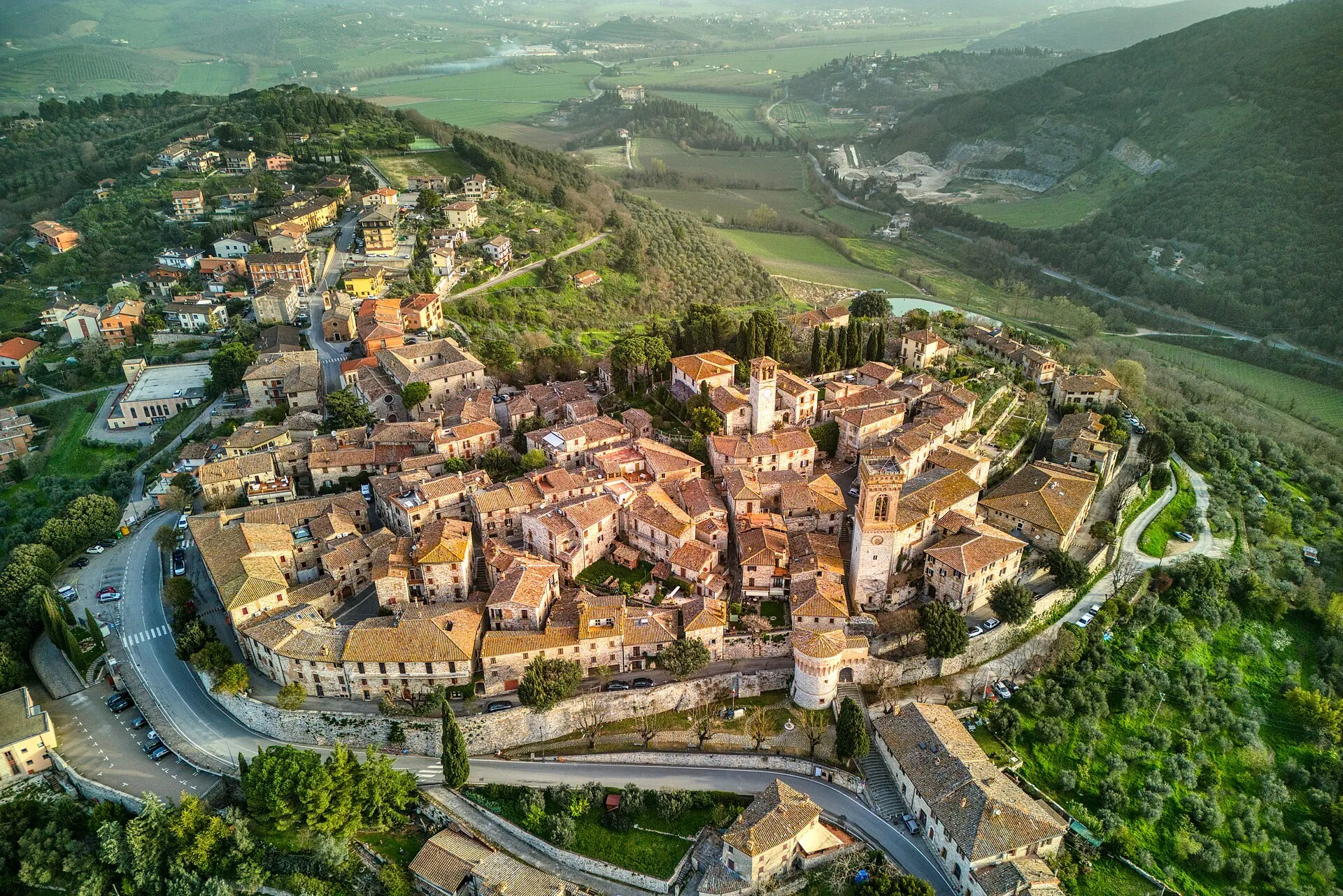
Corciano is officially one of the Borghi più belli d’Italia — the association of Italy’s most beautiful villages — and it earns the title honestly. Perched on a hill between Perugia and Lake Trasimeno, the village keeps its medieval shape almost intact: a ring of stone walls, a tangle of steep lanes, flower pots on every windowsill and views that stretch across the Umbrian countryside. From Casale Corciano it’s a five-minute drive.
The walled village
The best way to see Corciano is simply to walk it. Enter through the main gate and let the lanes pull you upward — the village is small enough that you can’t really get lost, and every turn frames another photograph: stone arches, hidden courtyards, the tower rising above the rooftops. Go slowly; this is a place for wandering, not for ticking off sights.
The walls themselves are the village’s monument. Built and rebuilt between the 13th and 15th centuries, they still circle the historic centre almost completely, punctuated by towers and gates. Walk the perimeter road at sunset for the full effect — the stone turns gold, and on clear days you can see all the way to the mountains.
Churches and a Perugino masterpiece
The parish church of Santa Maria Assunta, at the top of the village, holds Corciano’s artistic treasure: an Assumption of the Virgin painted by Pietro Vannucci — Perugino, Raphael’s teacher and Umbria’s greatest Renaissance painter. The church also keeps a 15th-century processional banner by Benedetto Bonfigli. Finding work of this calibre in a village this size is very much an Umbrian thing.
Nearby, the former church of San Francesco — 13th century, one of the early Franciscan churches — now serves as a museum and exhibition space.
Small museums, big charm
Corciano’s museums are tiny and delightful. The Museo della Casa Contadina recreates a traditional peasant house room by room, with the tools, furniture and everyday objects of rural Umbria as it was until a couple of generations ago. The Antiquarium gathers archaeological finds from the area, going back to the Etruscans. Neither takes more than half an hour, and both are worth it.
Just outside the village, the castle of Pieve del Vescovo — a fortified residence once used by the bishops of Perugia — makes a scenic stop on the way back down.
August: the Corciano Festival
If you visit in August, you’re in luck. For around two weeks the Corciano Festival (part of the Agosto Corcianese) fills the village with theatre, concerts, art exhibitions and historical re-enactments. The lanes glow with torchlight, taverns open in the courtyards, and the whole village becomes a stage. It’s one of the most atmospheric summer festivals in Umbria — and staying at Casale Corciano means you’re minutes away, with your car safely parked at home.
Practical tips
- Getting there: 5 minutes by car from the apartment. Park in the free areas just outside the walls and walk in — the historic centre is pedestrian.
- When to go: late afternoon is the sweet spot; the light is beautiful and the village is at its quietest. In August, evenings during the festival are magical but busier.
- Combine it with: Corciano pairs perfectly with a morning in Perugia or an afternoon at Lake Trasimeno — everything is within a 15-minute radius of the apartment. See our location page for all distances.